Counselling for life across cultures.

Berlin-based cognitive behavioural counsellor with a neuroscience research background. During my PhD, I used EEG—electroencephalogram, a method to record the brain’s spontaneous electrical activity—to study emotional processing in clinical populations, and eye-tracking to examine how infants and mothers process social cues. Now I bring that understanding of how the brain works under stress into my clinical practice.

I work with professionals and leaders navigating major life transitions—relocation, career shifts, identity change, burnout. When you’re caught between where you came from and where you’re going, clarity becomes possible.

Request a first call
Dr Fang Yang, counsellor in Berlin

A researcher who sits with people, not just data.

I work with professionals and leaders navigating major life transitions—career shifts, relocation, identity shifts. When you're overwhelmed, good decisions disappear and emotions won't cooperate with your thinking. My work in neurocognitive behavioural research helps me see the patterns underneath—and how to move through them. Starting over is harder than it looks.

I've lived and worked across Taiwan, the UK, the USA, France, Belgium, and Germany. I know the weight of starting over in a place that doesn't yet know you. That's why I'm here.

Read more →

Two practices, one integrated frame.

I combine Cognitive Behavioural Therapy (CBT) with an understanding of how culture and experience shape your nervous system. Your thinking patterns aren't universal, they're shaped by where you come from and where you are now. That gap is where the work happens.

Method 01

Cognitive Behavioural Therapy

Practical work to identify the thought patterns driving your day and build ones that survive pressure..

  • Notice automatic thoughts that trigger stress and anxiety
  • Learn tools that work under overwhelm, not just in calm
  • Move from reactive to structured thinking
Method 02

Neurocognitive Insight

Understand the architecture of your own mind—the defences you've built, the patterns you repeat, why you sabotage yourself. This isn't surface-level awareness. It's analytical work grounded in how your brain actually functions.

  • Identify the recurring patterns that limit you
  • Understand the logic behind your defences—they made sense once
  • See how past adaptations now work against you
  • Build new responses from genuine understanding, not willpower

The patterns people bring.

Most clients come carrying a few of these at once. We work with what is loudest first, then move outward.

Career transitions i.

Career transitions

Job changes, visa stress, the in-between of leaving one professional identity before the next has fully arrived.

Burnout ii.

Burnout

The slow erosion that comes from trying to keep up with two cultures, two languages, two sets of expectations.

Anxiety and overwhelm iii.

Anxiety & overwhelm

The body that will not settle, the mind that keeps running scenarios, the everyday tasks that have started to feel heavy.

Attachment and loss iv.

Attachment & loss

The grief of distance from people you love, and the patterns of relating that travel with you wherever you go.

Identity across cultures v.

Identity across cultures

Who you are in your mother tongue, who you become in another. The work of holding both without choosing.

Trauma vi.

Trauma

Working at a pace your nervous system can actually meet, with care for what is still tender.

A practice grounded in cognitive science.

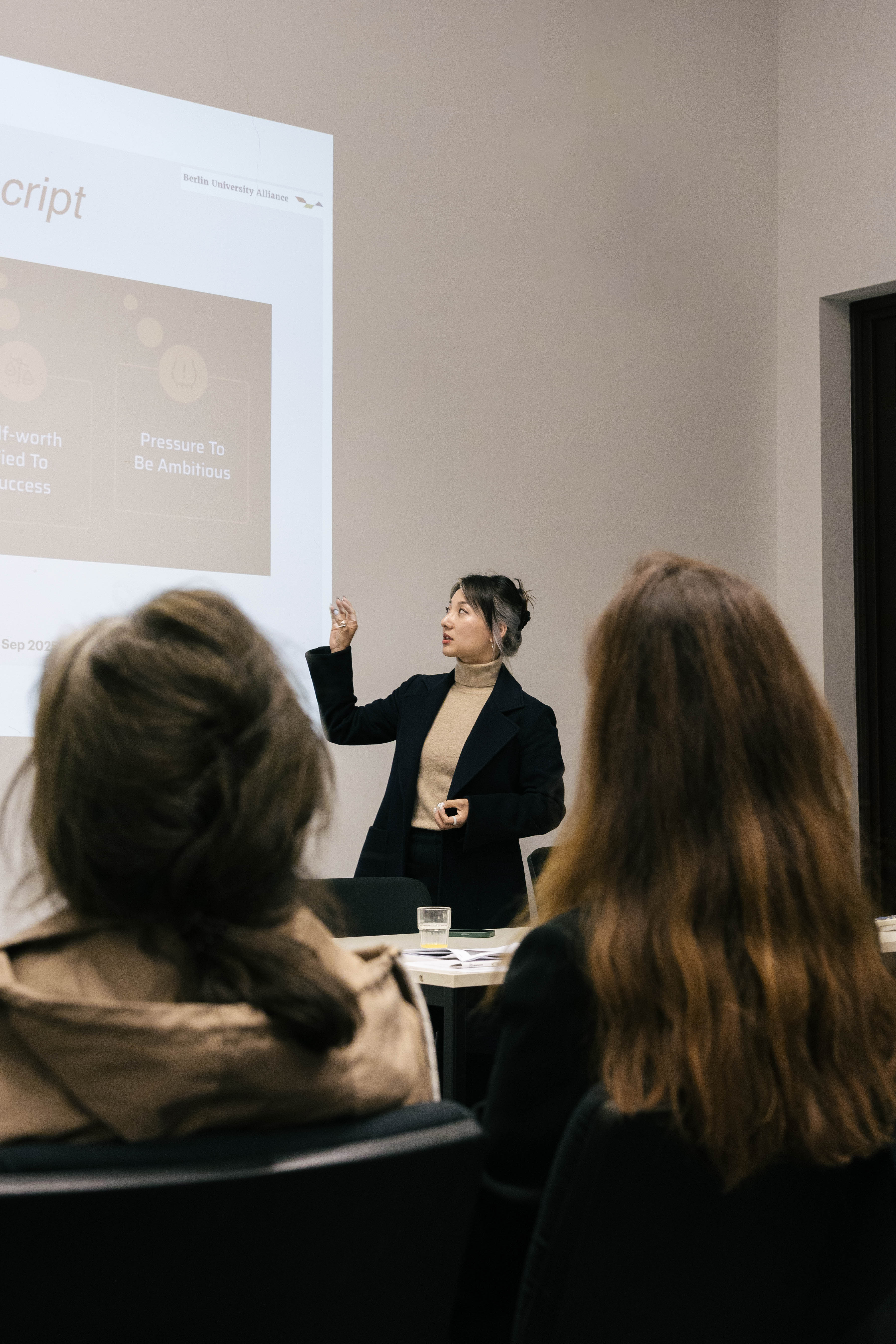
My counselling draws from a research background in cognitive psychology and neuroscience. I co-founded the EmoLeaders project (Berlin University Alliance), exploring how leaders navigate difficult situations across cultural and gender lines. Research and clinical work inform each other—they have to

Fang Yang teaching: self-worth, ambition, pressure
Emoleaders Workshop, 2025 · Photography by Shabnam Tavoosi

From people who have sat in this room.

A few words from clients about the work, in their own. Names and details lightly changed for privacy.

I came in burnt out and convinced I had failed at moving abroad. Fang did not try to fix me. She helped me see the script I was running and gave me actual tools. Six months later I feel like myself again, in Berlin, finally.
M., Product manager · German x France
What I did not expect was someone who actually understood the cultural piece. Most therapists I tried wanted me to just adapt. Fang made room for the part of me that is still very much from somewhere else.
J., Researcher · UK
Practical, warm, and deeply informed. The CBT work was structured enough to give me traction, and the cultural conversations gave me language for things I had been carrying for years.
L., Freelancer · USA x Taiwan

A few honest answers.

Where are sessions held?

Online via secure video, sessions run 50 minutes.

How long does therapy usually take?

It varies. Some clients come for a focused six to twelve sessions around a specific transition, others stay longer for deeper work. We talk about pacing openly.

Do you work with insurance?

I work as a private counsellor, so sessions are paid directly.

How do we start?

Ready to take the next step toward a balanced and fulfilling life in Berlin? We start with a short form, then a 20-minute introduction call (30 euros, online) so the time is actually useful.

Ready to begin?

If anything here resonated, that is usually a good sign. The first conversation is free and quiet.

Request a first call